From circular-economy idea to a pilot worth testing
A practical way to make an ambitious materials project more credible: narrow the first question, keep an evidence trail and distinguish assumptions from results.
Updated
Ambition becomes useful when it can be questioned
A circular-economy idea can connect many worthwhile goals: recovering material, reducing waste, making useful products and creating work. The difficulty is that those goals can become one large story before the practical questions underneath them have been answered.
Where will the material come from? How consistent is it? What processing does it need? Who would use the output, and what would make that output acceptable to them? A strong project does not avoid those questions. It organises the work around answering them.
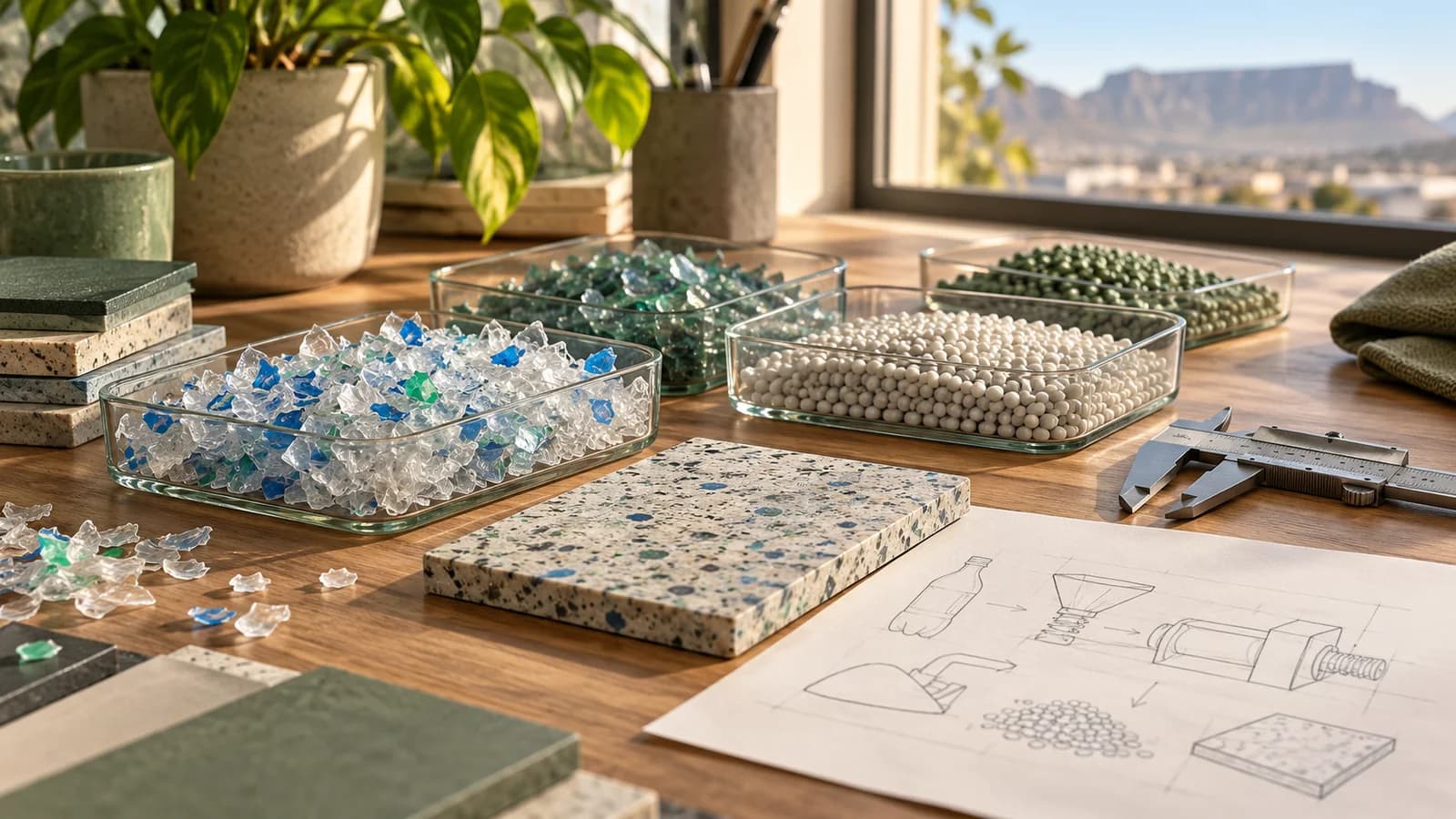
ShoshoSwift, presented in the portfolio as Project Circular SA, is a concept and validation project. This article is about how to plan that kind of early work responsibly. It is not evidence of an operating plant, secured funding, agreed buyers or measured environmental results.
Choose one material question first
A pilot needs a narrow question. An illustrative starting point might be whether a defined stream of collected plastic can be prepared into samples suitable for evaluation by a potential user. That question is more manageable than claiming a complete collection-to-manufacturing network.
Define the input boundary: what material is included, what is excluded, where a sample came from and how it was handled. Record observations such as contamination and variation rather than assuming every batch will behave the same way. A clean demonstration sample may not represent the ordinary material stream.
Then define what would count as useful evidence. A sample assessment, a repeatable preparation step or clear feedback on an output may be more valuable at this stage than a polished growth forecast. Let the question determine the experiment, not the other way around.
Keep a small, honest evidence register
An evidence register can be simple. Give each assumption an owner, note the source of the current information and record the next test. Label items as proposed, under investigation, tested or confirmed only when the supporting record justifies that label.
A discussion with a potential supplier is not a supply agreement. Interest from a potential buyer is not an order. A promising sample is not proof of consistent commercial output. Keeping those distinctions visible helps collaborators understand what they are being asked to contribute.
Preserve unsuccessful tests too. A failed preparation method may tell the team what not to repeat or reveal that the original input assumptions were wrong. Removing that history makes the project look tidier while making the next decision less informed.
Ask for resources against a learning milestone
Early resource planning should explain what the team needs to learn and who will do the work. Identify the roles required for the next phase, the expected activities, the equipment or services needed and the point at which the evidence will be reviewed. Do not present an unfunded plan as an established team.
Separate once-off setup from ongoing work. Development time, hosting, sample preparation and external assessment have different purposes and may run on different timelines. Cost assumptions should be recorded with their source and reviewed before they become a funding request. This article does not substitute for a verified project budget.
Include a decision gate. If the input cannot be obtained consistently, or the output does not meet the intended use, what changes? A credible pilot gives the team permission to stop, narrow or redesign the idea. Continuing indefinitely is not the same as making progress.
Share progress without turning the concept into a claim
Public updates are most useful when they explain what was attempted, what was learned and what happens next. A concept rendering can help someone understand a direction, but it must not be presented as a photograph of an operating facility. The same care applies to projected jobs, capacity and revenue: a target is not a result.
Before moving from concept work into physical processing, get the appropriate specialist input for the actual location, materials, equipment and intended activity. Safety, environmental and other applicable requirements cannot be inferred from a website or a generic process sketch. Their review belongs in the project plan, not in a footnote after work has started.
For a partner considering involvement, a focused question and a clear evidence trail make a better conversation possible. They can challenge the assumptions, suggest a relevant test or explain why a proposed output would not meet their needs. That feedback is useful even when it changes the original vision.
The next step for an early circular-materials project is therefore not a bigger claim. It is a better-defined experiment: a specified input, a responsible team, a record of the test and a decision that follows from the result. That is how ambition starts becoming something people can evaluate.
Keep exploring
All articles →
Beyond the Matrix—What Films Can Teach Us About Living on Autopilot
Are we the player, the character, or both? An open conversation about The Matrix, games, faith and the choices we can actually make—without needing everyone to agree.

When Fear Becomes the World We Live In
Sometimes what keeps us stuck is not what is happening, but the story we have come to believe about what might happen.